Blog
The Next Refinance Deal Is Hidden in the Data
Lessons from Ryan Granito on mortgage maturity data, title records, AI-supported refinance sourcing, and real-estate finance.

In real-estate finance, finding more deals is not enough. A producer needs to find the small set of opportunities that can close.
I spoke with Ryan Granito of Concord Summit Capital about refinancing, capital markets, and where AI could help source viable opportunities.
Start with the signals in the record
Ryan described a sourcing workflow built around mortgage maturity, loan amount, rate, property type, and title records. Those fields can indicate whether an owner faces a financing gap when a loan matures.
The challenge is turning a broad universe of records into a short, defensible outreach list. A loan coming due does not automatically create an opportunity. The debt terms, asset, sponsor, market, and available capital all shape whether a refinance has a real path forward.
Use AI to prioritize, not to invent
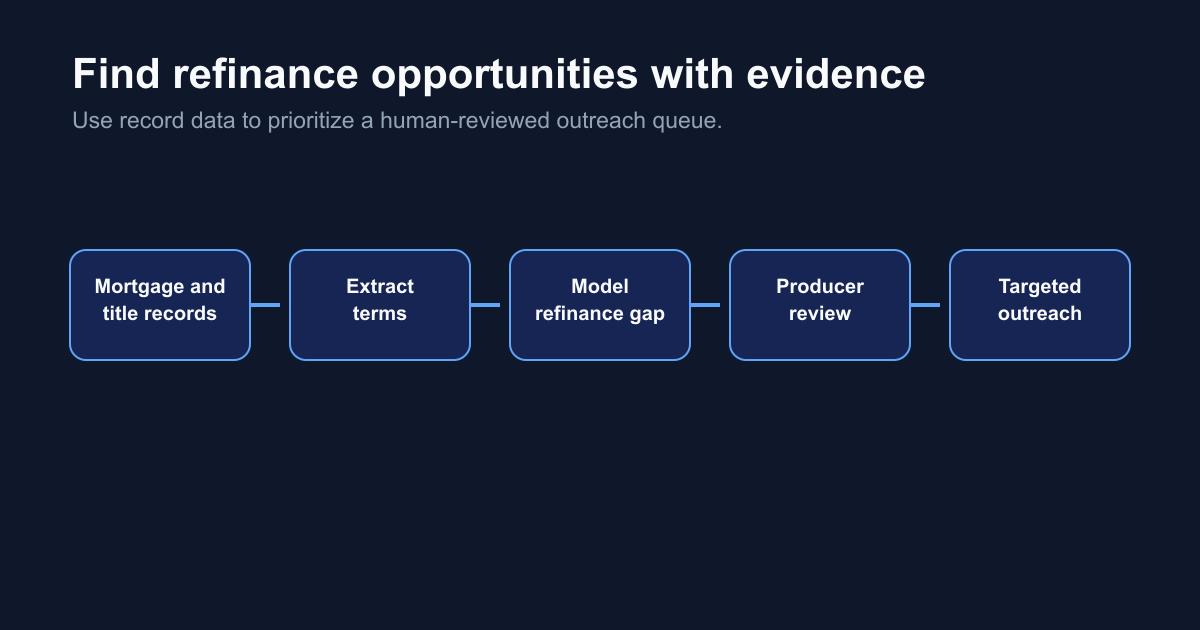
An AI system could extract terms from trust deeds and notes, model a potential refinance, and rank opportunities for human review. It could flag a low-rate loan reaching maturity, estimate the change in debt service at current rates, and identify the likely shortfall.
Every recommendation needs the source record and assumptions attached. A producer should be able to see why a deal reached the list, review the relevant documents, and decide whether the opportunity is worth a call.
This is an important design boundary. The model can reduce reading and calculation work. It should not produce unexplained deal advice or replace underwriting judgment.
Data access shapes the product
Ryan pointed to title-company data as a potentially valuable part of the workflow. It can surface mortgage information and property details, though the most useful records may have a per-record cost.
That makes search design important. Teams need parameters that narrow a large dataset to a realistic segment: product type, geography, maturity window, loan size, and other signals connected to the strategy.
A practical system should also keep source provenance. If a deal is prioritized because a mortgage matures next year, the user needs to see the title or recorded document that supports the claim.
My LLM Contact Discovery work came up in the conversation. That project turns scattered university pages into contact records with source links and review controls. The connection to his sourcing idea is the research workflow: narrow the search, gather evidence, and give the person making the call a list they can check.
Close the loop with outcomes
The useful metric is not how many records the system found. It is whether the prioritized queue leads to qualified conversations, credible underwriting, and completed transactions.
Ryan described a market where many sponsors face refinancing pressure while lenders and equity providers have become more selective. That makes precision more valuable. An AI workflow can help producers focus their research on the deals where a well-structured solution may actually be possible.
My takeaway: the useful AI opportunity is not a generic deal list. It is a transparent queue of refinance opportunities with enough evidence for a producer to act.