Blog
SEO for AI Search: Lessons from Geoff Kenyon
Practical lessons on SEO, AEO, GEO, local authority, technical crawlability, and measuring visibility in AI search.

I recently spoke with SEO expert Geoff Kenyon about how search is changing as people use ChatGPT, Claude, Gemini, and Perplexity to find companies and experts.
We used a recent client as a practical example. One idea kept coming up: visibility in AI search depends heavily on evidence that a company is credible, relevant, and connected to its market.
Here are my main takeaways.
Authority is built across the web
Publishing useful content on your own site still matters. AI search systems may also encounter interviews, podcasts, reviews, association pages, local publications, event sponsorships, and other independent references.
Together, those sources help establish what an organization does, where it operates, and whether other people trust it.
Geoff shared a recent example from his own business. A prospective client used Claude to research SEO experts. Claude surfaced Geoff after finding signals from his body of work across the web. The client then found his website and contacted him.
The practical lesson is to create work worth citing and make your expertise easy to verify. For a local business, that could include:
- Interviews with named leaders
- Detailed customer reviews that mention services and locations
- Bylined articles in relevant publications
- Memberships and contributions to industry associations
- Original operating statistics with dates and methodology
These references create a clearer entity around the business and the people behind it.
A useful way to think about this is an authority flywheel:
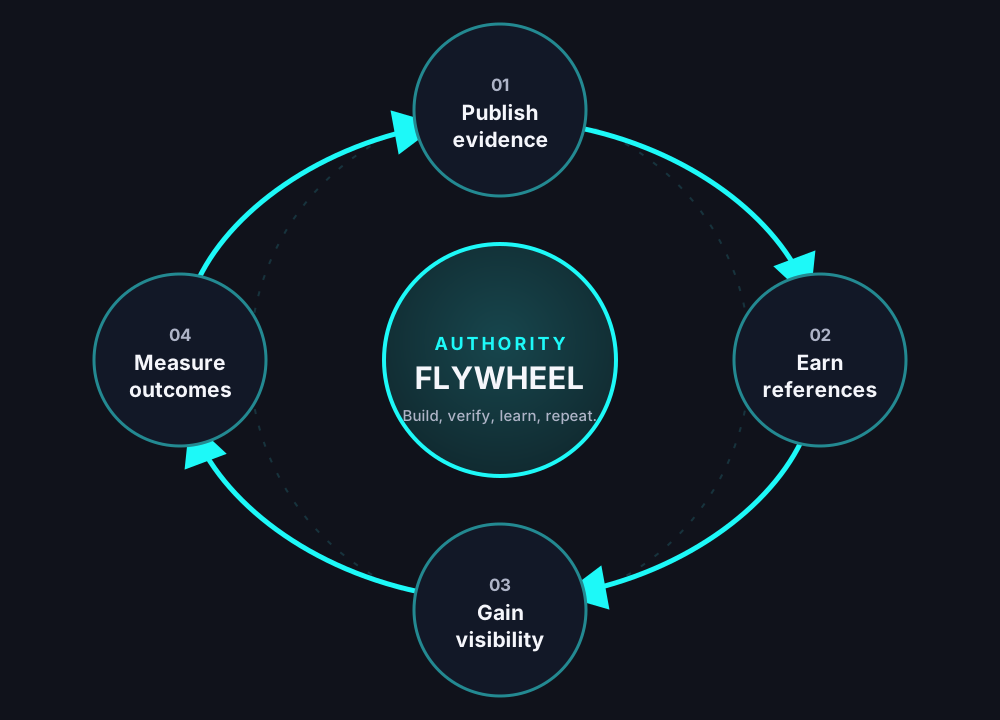
Useful evidence creates opportunities for independent references. Those references support discovery in search and AI answers. Qualified outcomes then show which subjects and sources deserve the next investment.
Local signals should be explicit
Local relevance benefits from specific language.
Geoff suggested sponsoring a community event and asking for a crawlable sponsor page that names the company, service category, and community in text.
That wording gives crawlers more context than a logo alone. The same principle applies to directory listings, review profiles, media mentions, and Google Business Profiles. Consistent names, services, and locations help connect the references.
For businesses serving several communities, each important market should have real supporting evidence. City pages can answer local questions, while partnerships, reviews, and community involvement reinforce the relationship.
Useful content needs supporting evidence
AEO and GEO content should answer focused questions that prospective customers actually ask.
For a local service business, those questions might cover pricing, timelines, process, common risks, or differences among nearby markets. A strong answer can include a concise summary, clear sections, relevant statistics, an FAQ, and a named expert.
Original data can be especially valuable when readers can understand where it came from. Publish the time period, sample size, methodology, and local context. This makes the information easier for people, search engines, and AI systems to evaluate.
Specificity is the standard. A focused collection of useful pages with evidence can build meaningful authority. This matches Google’s guidance on helpful, reliable content, which emphasizes clear sourcing, first-hand expertise, and content that helps readers achieve a goal.
Technical SEO remains the foundation
Important content, metadata, links, and structured data should be available in the initial HTML. Marketing pages should load quickly, remain accessible, and give crawlers a clear internal-link structure. Google’s structured data documentation explains how standardized markup provides explicit clues about a page’s meaning.
Page builders can add markup and scripts that make those goals harder to reach. WordPress can work well when it is kept lean. A static-first framework such as Astro can also provide fast, crawlable pages when that fits the team and publishing workflow.
Performance should be measured as well as observed. Core Web Vitals track loading performance, responsiveness, and visual stability through LCP, INP, and CLS.
File size deserves attention too. Google currently documents that it fetches the first 2 MB of supported HTML-like files and up to 64 MB for PDFs. Content after the supported limit may not be crawled. External page resources are fetched separately. See Google’s documentation on file-size limits.
The exact framework matters less than the result: useful information should reach the crawler quickly and reliably.
Measure visibility through business outcomes
Rankings provide one view of performance. AI search adds more signals to monitor, including brand mentions, recommendations, citations, and the sources used in generated answers.
A repeatable prompt set can help track those signals across Google, Gemini, ChatGPT, Perplexity, and Claude. Run the prompts from a consistent location and a clean session, then record how the answers and cited sources change over time.
The stronger measurement loop connects that visibility to qualified leads, signed clients, and revenue. GA4 and Google Tag Manager can capture form starts, submissions, phone clicks, email clicks, consultation requests, and thank-you page visits. CRM outcomes can show which interactions became real customers.
Avoid inferring personal details from a page visit or search phrase. Use page and campaign context as broad intent signals, then ask a clear qualifying question in the lead form.
A practical starting point
For a local company improving its visibility in traditional and AI search, I would start with four steps:
- Make the site fast, accessible, crawlable, and clear.
- Publish direct answers supported by local experience and original evidence.
- Build third-party references through customers, communities, experts, and publications.
- Track visibility and connect it to qualified business outcomes.
My biggest takeaway from Geoff was that SEO, AEO, and GEO share the same core requirement: give people and machines credible evidence that you know the subject and serve the market you claim.