Blog
How AI Can Give HR More Time for Human Judgment
Lessons from Dr. Amaziah Dominic on AI in HR, skills-based hiring, bias checks, onboarding, translation, and employee experience.
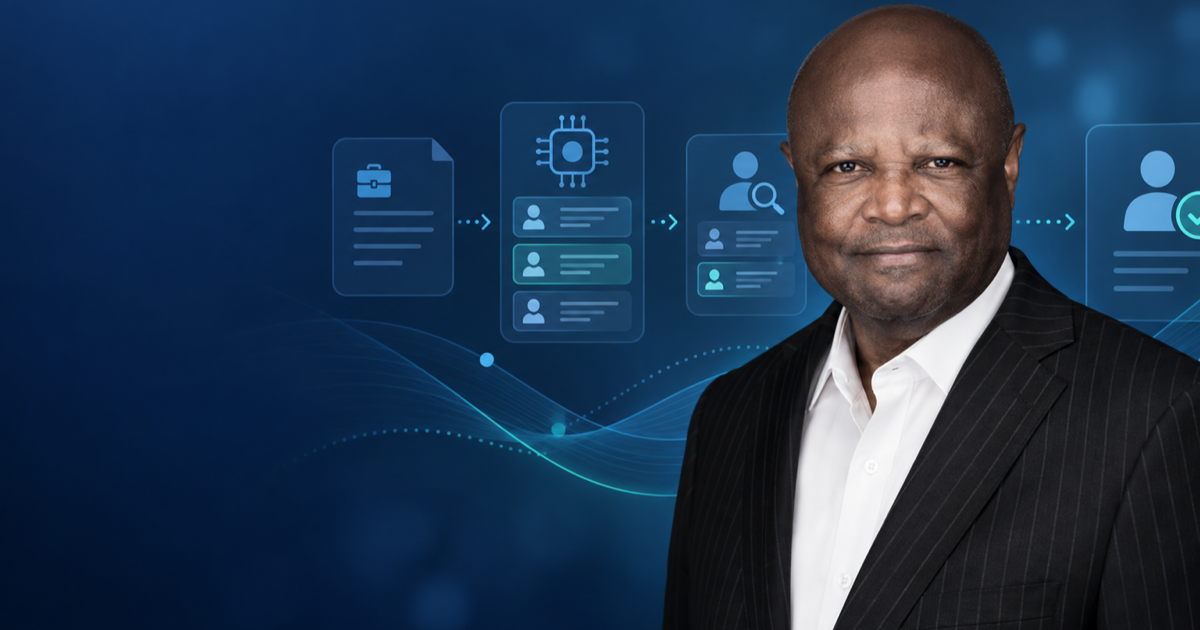
HR teams can spend hours reviewing applications before they speak with a single candidate. AI can shorten that work, but speed is only one measure of a useful hiring process.
I recently spoke with Dr. Amaziah Dominic, an I/O psychologist and leader with Community Literacy Centers, about practical AI applications in HR and nonprofit work.
Dom has spent 30 years in military service, worked in insurance, earned a Ph.D. in I/O psychology, and supported adult literacy programs in Oklahoma. His perspective connects technology decisions to the people affected by them.
One question shaped our conversation: does an AI-supported process improve the employee experience?
Start with the requirements of the role
Dom described résumé review as an immediate use case. An HR team can define the experience, certifications, skills, and education required for a position, then use AI to organize applicants around those criteria.
He has seen a review process that took about five hours fall to 30 minutes or one hour. That time matters because it can return attention to interviews, relationships, judgment, and candidate support.
The criteria still require careful design. A filter may look relevant while acting as a proxy for background or access. Dom used participation in Future Farmers of America as an example. An employer could treat that affiliation as a preferred signal and unintentionally narrow the candidate pool.
A stronger workflow asks what the job actually requires:
- Which skills predict success in the role?
- Which certifications are necessary?
- Which experience can be demonstrated in several ways?
- Is a degree required for the work?
- Which screening fields could act as proxies for demographic background?
AI can apply those rules consistently. The team remains responsible for the rules and their effects.
flowchart LR
  A[Define job requirements] --> B[AI organizes applicants]
  B --> C[Review qualified candidates]
  C --> D[Structured interview]
  D --> E[Audit outcomes]
  E --> A
Measure who advances through the process
Dom has observed unconscious bias during interview processes. He recalled African American names receiving more questions while other applicants moved forward with less scrutiny.
An AI system does not remove that risk by itself. It can repeat the assumptions in training data, job descriptions, historical decisions, or the instructions provided by a hiring team.
The workflow needs observable checkpoints. Teams can record which criteria affected a recommendation, review a sample of rejected applications, compare advancement rates, and investigate unexpected differences. A recruiter should be able to see why an applicant was included or excluded.
This turns fairness into an operating practice. The organization can test whether its stated requirements match its actual decisions.
Use saved time across the employee journey
Dom sees useful AI applications beyond initial screening. A system can help draft job descriptions, prepare structured interview questions, send candidate instructions, and answer common onboarding questions about benefits or paid time off.
These tasks share a useful property: they repeat often and rely on known information. A team can define an approved source, test common questions, and route uncertain cases to an HR professional.
The same pattern can improve access to workplace information. Dom described using AI to translate instructions for people who do not speak English, followed by review from someone who knows the target language.
That human review matters. A translation can sound fluent while changing a policy, deadline, safety instruction, or eligibility rule. The reviewer needs the original text, the translated version, and a clear way to report a correction.
Keep interpretation with the people responsible
Dom compared AI research with the library work required earlier in his career. A system can now gather information from many sources in seconds. The harder task is deciding whether the information is qualified, relevant, and fairly represented.
That distinction applies to hiring. AI can sort records, find patterns, prepare drafts, and surface candidates who match defined requirements. HR professionals still need to understand motivation, evaluate organizational fit, exercise judgment, and remain accountable for the decision.
The same principle applies when an organization chooses an AI tool. Community Literacy Centers works with a local specialist who helps the team identify products that fit a specific need. That guidance can be valuable for a smaller organization that does not need to build a custom system.
A practical selection process begins with four questions:
- What task should become faster or more reliable?
- Which information must the tool access?
- How will the team test accuracy and fairness?
- Who owns exceptions, corrections, and ongoing review?
These questions are especially important when the source material includes confidential employee, applicant, insurance, or benefits information.
That review step has a close parallel in my AI Instructor Validation project. It checks instructor access requests against official university sources and sends ambiguous cases to a person for approval. The useful connection to Dom’s point is making the evidence and next step clear. Hiring adds its own requirements for fairness and judgment.
Make employee experience a success metric
An HR automation can save time and still create confusion. A candidate may receive faster messages with less useful information. An employee may get an immediate answer that misstates policy. A recruiter may receive a ranked list without enough context to challenge it.
Time saved should be measured alongside the quality of the experience. Useful signals include candidate response time, completion rates, corrected answers, escalations, accessibility, employee trust, and the time HR staff can spend on higher-value conversations.
My biggest takeaway from Dom was that AI in HR should create capacity for better judgment. A well-designed system helps qualified people reach the hiring team, gives employees quicker access to reliable information, and makes the decision process easier to inspect.
That is a practical standard for AI-assisted HR: clear requirements, narrow access, measurable outcomes, and named people responsible for the result.